
Henry Wadsworth Longfellow: The Poet Who Gave America Its Voice
Henry Wadsworth Longfellow stands as one of the most beloved and influential poets in American literary history. At a time when the United States was still shaping its cultural identity, Longfellow offered something rare: poetry that was both elevated and accessible, rich in feeling yet grounded in clarity. His work reached millions, crossing oceans and languages, and helped establish American poetry as a force worthy of global attention. Read more about his life at Henry Wadsworth Longfellow - Wikipedia.
Longfellow’s appeal endures because he understood something essential about human nature. He wrote about courage, sorrow, hope, memory, and the quiet heroism of everyday life. His poems were crafted not for an elite audience but for anyone who sought meaning in the world around them. That democratic spirit combined with his musical language made him a household name in the 19th century and a lasting presence in classrooms and libraries today.
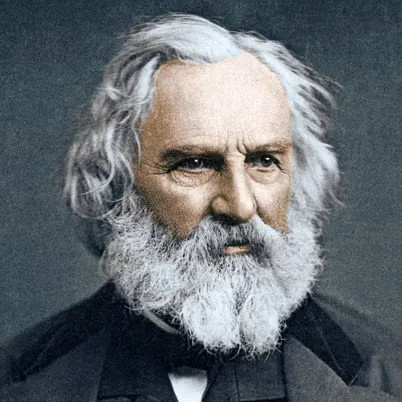
Henry Wadsworth Longfellow… became a household name as the poet that wrote about courage, sorrow, hope, memory and the quiet heroism of everyday life.
A Poet of Heartfelt Simplicity
Longfellow’s style is often described as gentle, melodic, and sincere. He favored themes that spoke to universal human experiences, and he believed deeply in the moral power of literature. His poems rarely hide behind abstraction; instead, they invite readers into a shared emotional space.
One of his most famous short works, “The Arrow and the Song,” captures this simplicity and depth beautifully. In just a few lines, Longfellow reflects on the unseen impact of our actions…how words and deeds travel farther than we imagine:
I shot an arrow into the air,
It fell to earth, I knew not where;
For, so swiftly it flew, the sight
Could not follow it in its flight.
I breathed a song into the air,
It fell to earth, I knew not where;
For who has sight so keen and strong,
That it can follow the flight of song?
Long, long afterward, in an oak
I found the arrow, still unbroke;
And the song, from beginning to end,
I found again in the heart of a friend.
The poem concludes with the discovery that both the arrow and the song…symbols of action and expression have found lasting homes. It’s a gentle reminder that kindness, creativity, and even careless moments ripple outward in ways we may never fully understand.
A Voice of Resilience and Purpose
Longfellow’s life was marked by profound personal tragedy, including the loss of two wives. Yet his poetry often turns toward hope rather than despair. He believed in perseverance, in the dignity of striving, and in the possibility of renewal. Nowhere is this clearer than in “A Psalm of Life,” written in 1845 and one of his most enduring works. Read the poem at Longfellow: A Psalm of Life, Voices of the Night - HENRY WADSWORTH LONGFELLOW
The poem is a call to action…a reminder that life is not meant to be observed passively but lived with intention. Later, he urges readers to leave behind a legacy of courage. These lines resonated deeply with 19th‑century Americans, many of whom were navigating a rapidly changing nation. They still resonate today, offering a steadying voice in moments of uncertainty.
A Bridge Between Worlds
Longfellow was not only a poet but also a scholar and translator. His translation of Dante’s Divine Comedy was the first American version of the epic and helped introduce countless readers to European literary traditions. He believed that literature could connect cultures, and he saw poetry as a universal language….one capable of building bridges across time, geography, and experience.
His narrative poems, such as “The Song of Hiawatha” and “Evangeline,” brought American stories to life with a sense of grandeur that rivaled European epics. He helped shape the mythology of a young nation, giving Americans a shared cultural memory.
Why Longfellow Still Matters
In an age of irony and fragmentation, Longfellow’s earnestness feels almost radical. He wrote with a belief in goodness, in the power of beauty, and in the importance of striving toward something greater than oneself. His poems remind us that literature can be both comforting and galvanizing…that it can soothe the heart while stirring the spirit.
Longfellow once wrote, “Music is the universal language of mankind.” His poetry, with its rhythmic grace and emotional clarity, became a kind of music in its own right. It continues to speak across generations because it speaks to something timeless in us: the desire to understand our place in the world and to leave it better than we found it.
Longfellow’s legacy is not just in the poems he wrote but in the millions of readers who found courage, comfort, and inspiration in his words. He remains, in many ways, the poet laureate of the American soul.